


Telescope Master is reader-supported. As an Amazon Associate I earn from qualifying purchases. If you buy through links on our site, we may earn an affiliate commission at no extra cost to you. Full disclosure.
Capture the cosmos the way it’s meant to be seen. A quality astrophotography filter reduces interference and brings out the subtle beauty of planets, galaxies, and star clusters.
In this article, we’ll explore some of the best astrophotography tools and filters for telescopes that can make your stargazing easier and more enjoyable. Whether you are a beginner or a seasoned astronomer, these filter options will help you capture breathtaking images with less hassle. Keep reading to find the perfect filter that fits your needs and enhances every night of observing.
1. Svbony Telescope Filter Uhc Filter
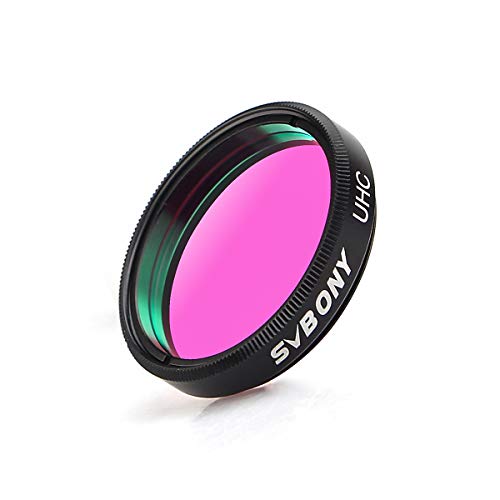
The SVBONY Telescope Filter 1.25″ UHC Filter is ideal for amateur astronomers and astrophotography enthusiasts looking to enhance their night sky viewing experience. If you are someone who wants to reduce light pollution and improve the contrast of celestial objects, this filter is a perfect addition to your telescope setup.
Pros:
- Effectively reduces light pollution for clearer images
- Improves image contrast for better visibility of nebulae and other deep-sky objects
- Compact and lightweight with a standard 1.25 inch size compatible with most telescopes
- Durable black finish from the trusted SVBONY brand
Cons:
- May slightly reduce overall brightness of some objects
- Best performance in areas with moderate light pollution, less impact in extremely dark skies
The SVBONY UHC Filter is designed with a 1.25 inch diameter, making it compatible with most standard telescopes and eyepieces. Its primary feature is the ability to filter out unwanted wavelengths of light from urban light pollution, allowing faint celestial objects like nebulae to appear brighter and with more detail. This makes it especially beneficial for astrophotographers aiming to capture clearer and higher-contrast images without excessive post-processing.
In addition to improving image contrast, the filter enhances the overall viewing experience by allowing users to see subtle features in deep-sky objects that are often washed out by artificial lights. Its lightweight and compact design ensure it is easy to attach and remove, making it a convenient tool for both casual stargazing and serious astrophotography sessions. Overall, this filter from SVBONY offers excellent value for anyone seeking to elevate their telescope’s performance under light-polluted skies.
To buy this product, click here.
2. Svbony Sv220 Telescope Filter

The SVBONY SV220 Telescope Filter is ideal for amateur and professional astrophotographers who use one-shot color cameras and seek to enhance their celestial imaging. If you want to reduce light pollution and capture clearer, more detailed nebula images, this 7nm dual-band narrowband filter designed for H-Alpha and O-III wavelengths is perfect for your setup.
Pros:
- Effectively reduces light pollution for clearer night sky images
- Dual-band design targets both H-Alpha and O-III nebula emissions
- Compatible with 2-inch telescope eyepieces and one-shot color cameras
- Lightweight and compact with precise dimensions for easy installation
- Enhances contrast and detail in astrophotography by isolating narrow spectral bands
Cons:
- May not be suitable for monochrome cameras or other filter sizes
- Limited to specific emission lines; not ideal for broadband imaging
The SVBONY SV220 Filter features a 7nm bandwidth that precisely isolates the H-Alpha and O-III emission lines, which are crucial for capturing vivid nebula details. By targeting these specific wavelengths, the filter effectively blocks out unwanted light pollution from urban environments, resulting in sharper and more vibrant images of deep-sky objects. Its dual-band design allows users to capture rich colors and finer details in a single shot without the need for multiple filters or complex setups.
Measuring just 2 inches in diameter and weighing a mere 0.066 pounds, this filter is designed for easy integration with standard telescope eyepieces and one-shot color cameras. This compact size ensures minimal vignetting and optimal light transmission, enhancing the overall imaging experience. Users benefit from improved contrast and reduced background noise, enabling longer exposure times and clearer astrophotography results even in light-polluted areas.
To buy this product, click here.
3. Neewer 1.25 Inches Telescope Moon Filter

The Neewer 1.25 inches Telescope Moon Filter and accompanying 5 Color Filters Set is ideal for astronomy enthusiasts and amateur astronomers who want to enhance their lunar and planetary observations. If you are passionate about stargazing and desire clearer, more detailed views of celestial bodies, this filter set is designed to improve your viewing experience by increasing definition and resolution.
Pros:
- Enhances lunar and planetary detail by reducing glare and improving contrast
- Includes five color filters (Red, Orange, Yellow, Green, Blue) for versatile observational options
- Compact and lightweight design with dimensions of 1.25 inches in diameter, making it easy to attach to eyepieces
- Durable and high-quality CPL (Circular Polarizer) filter for better image clarity
- Compatible with most telescopes using a 1.25-inch eyepiece mount
Cons:
- May not fit telescopes with eyepiece sizes other than 1.25 inches
- Color filters may require practice to select the best filter for specific celestial objects
- Filters can slightly reduce brightness, which might affect viewing of very faint objects
The Neewer Telescope Moon Filter is engineered to significantly improve the clarity and sharpness of lunar and planetary observations. By reducing the glare caused by bright moonlight or planetary reflections, it allows users to see surface details with greater precision. The inclusion of a CPL filter further enhances image quality by minimizing reflections and unwanted light, making it easier to observe intricate features on the moon and planets.
The set’s five color filters provide a versatile range of options to optimize views depending on atmospheric conditions and target objects. For instance, the red and orange filters can enhance surface contrasts on Mars, while blue and green filters help in observing cloud patterns on Jupiter or Saturn. The lightweight and compact design ensures easy attachment to the telescope’s eyepiece without adding bulk, making it a practical accessory for both beginners and experienced astronomers seeking to elevate their celestial viewing experience.
To buy this product, click here.
4. Svbony Sv220 Telescope Filter

The SVBONY SV220 Telescope Filter is ideal for amateur and professional astrophotographers who use one-shot color cameras and seek to enhance their deep-sky imaging. This filter is perfect for those looking to reduce light pollution and capture crisp, high-contrast images of nebulae by isolating the H-Alpha and O-III narrowband emission lines. If you want to improve your astrophotography results without expensive modifications to your equipment, this filter is a great choice.
Pros:
- Effectively reduces light pollution for clearer astrophotography images
- 7nm dual-band design isolates key nebula emission lines: H-Alpha and O-III
- Compatible with one-shot color cameras for convenient use
- Compact 1.25-inch size fits most telescopes easily
- Lightweight and durable construction from SVBONY
Cons:
- May not be suitable for cameras other than one-shot color types
- Limited to narrowband imaging, less versatile for broad spectrum photography
- Small size may require adapters for some telescope setups
The SVBONY SV220 Telescope Filter features a precise 7nm bandwidth that targets the crucial emission lines of nebulae, namely H-Alpha and O-III. This selective filtering greatly reduces unwanted light pollution from urban environments, allowing users to capture more detailed and vibrant astrophotography images. The filter’s design ensures that only the desired wavelengths pass through, enhancing contrast and clarity without compromising color fidelity in one-shot color cameras.
Its compact 1.25-inch size ensures easy installation on most telescopes, making it accessible for users of various setups. The lightweight and sturdy construction by SVBONY offers durability for extended use in field conditions. By integrating this filter into your astrophotography gear, you can significantly improve your ability to capture stunning nebula images with reduced background interference, making it a valuable addition for both beginners and experienced astrophotographers alike.
To buy this product, click here.
5. Svbony Telescope Filter 2″ Uhc Filter
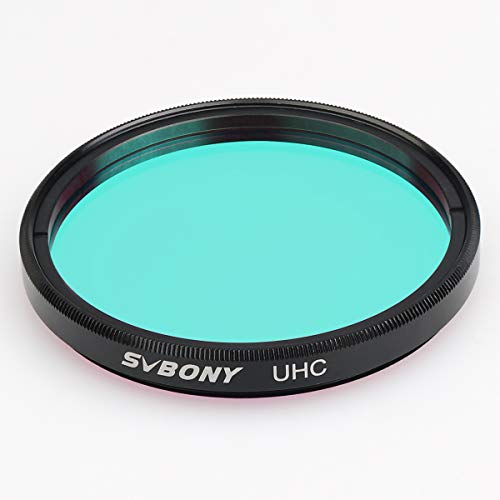
The SVBONY Telescope Filter 2″ UHC Filter is ideal for astronomy enthusiasts who are passionate about observing deep sky objects such as nebulae and galaxies. This filter is especially suitable for users who face challenges with light pollution and want to enhance the clarity and contrast of their celestial observations. Whether you are an amateur astronomer or a seasoned stargazer, this filter is designed to improve your viewing experience significantly.
Pros:
- Enhances contrast by reducing light pollution for clearer views of deep sky objects
- Compact and lightweight design with dimensions: Height 0.039 inches, Width 1.89 inches, Length 2.95 inches
- High-quality build from trusted brand SVBONY ensuring durability and reliability
- Easy to install and compatible with standard 2-inch telescope eyepieces
Cons:
- May slightly reduce brightness of brighter celestial objects due to filtering
- Limited to use primarily in urban or light-polluted environments for best results
The SVBONY UHC Filter is engineered to selectively transmit the specific wavelengths of light emitted by deep sky objects while blocking out the unwanted ambient light caused by streetlights and other sources of light pollution. This results in a striking improvement in the visibility of faint nebulae and other celestial phenomena, making it easier to distinguish fine details in your telescope view. The ultra-high contrast feature ensures that observations are sharp and vibrant, elevating your stargazing sessions to a professional level.
Constructed with precision and compatible with a wide range of telescopes, this filter is not only effective but also user-friendly. Its slim and lightweight dimensions make it easy to handle and attach without adding bulk to your telescope setup. Overall, the SVBONY Telescope Filter 2″ UHC Filter is a valuable accessory that enhances the quality of your astronomical observations by combating light pollution and increasing contrast, making it a must-have for anyone serious about deep sky exploration.
To buy this product, click here.
6. Svbony Sv240 Telescope Filter

The SVBONY SV240 Telescope Filter is ideal for astrophotography enthusiasts and amateur astronomers who want to enhance their viewing and imaging experience of deep-sky objects such as galaxies and nebulae. This filter is perfect for those seeking to reduce light pollution effects and capture clearer, more vivid images of celestial phenomena using their telescope.
Pros:
- Multi-narrowband design enhances visibility of Ha, OIII, and H-Beta emission lines for improved astrophotography.
- 2-inch universal size fits most telescopes, making it highly versatile.
- Near-infrared (NIR) filtering reduces light pollution, delivering clearer and more detailed images.
- Lightweight and compact dimensions (2.0 inches diameter, 0.039 inches thickness) for easy handling and installation.
- High-quality manufacturing by SVBONY, ensuring durability and reliable performance.
Cons:
- May require specific camera or telescope compatibility for optimal results.
- Not suitable for wide-field astrophotography without additional equipment adjustments.
The SVBONY SV240 Telescope Filter stands out with its ability to selectively transmit key narrowband wavelengths such as Hydrogen-alpha (Ha), Oxygen-III (OIII), and H-Beta. This selective filtering allows astrophotographers to capture the glowing gases of nebulae and galaxies with enhanced contrast and reduced interference from artificial light sources. Its near-infrared light pollution reduction capabilities are especially beneficial for users observing from urban or suburban areas where ambient light can hamper clarity.
Constructed with precision by SVBONY, this filter fits seamlessly onto most telescopes with a 2-inch diameter, making it a universal choice for many setups. Its slim profile ensures it does not add bulk or weight, allowing for easy integration into existing equipment. By using this filter, users can achieve sharper, more detailed images of deep-sky objects, making it an excellent investment for anyone passionate about astrophotography and night sky observation.
To buy this product, click here.
Frequently Asked Questions
What Is A Uhc Filter And How Does It Help Astrophotography?
A UHC (Ultra High Contrast) filter reduces light pollution and enhances contrast. It blocks unwanted light wavelengths, improving deep sky object visibility. SVBONY’s UHC filters are designed for telescopes to deliver clearer, sharper images during astrophotography sessions.
How Do Narrowband Filters Improve Nebula Imaging?
Narrowband filters isolate specific wavelengths like H-Alpha and O-III. This reduces light pollution and enhances nebula details. SVBONY’s dual-band filters are ideal for one-shot color cameras, providing high contrast and better visibility of faint nebula structures.
Why Use A Moon Filter For Lunar Observation?
Moon filters reduce brightness and glare from the moon’s surface. They enhance detail and improve viewing comfort through telescopes. Neewer’s moon and color filter set offers multiple options to optimize lunar and planetary observations with better resolution.
What Is The Purpose Of A Telescope Filter Drawer?
A filter drawer holds filters securely in the optical path. It allows quick filter changes without disturbing the telescope setup. SVBONY’s filter drawer supports 2” filters and adapts to various camera mounts, improving efficiency in deep sky astrophotography.
Can Multi-narrowband Filters Work With Full-frame Cameras?
Yes, multi-narrowband filters like SVBONY SV240 support full-frame cameras. They block near-infrared light and reduce pollution across multiple bands. This enhances galaxy and nebula imaging by capturing clear, high-contrast astrophotography photos.
Conclusion
Choosing the right astrophotography filters can greatly improve your telescope’s performance. Filters like the SVBONY UHC and Dual-Band Nebula options help reduce light pollution and boost image contrast. Moon and color filters from Neewer add clarity and enhance details in lunar and planetary views.
Using a filter drawer, such as the SVBONY SV226, allows easy swapping of different filters during observation. These filters work well with full-frame cameras and various telescope sizes. They help capture clearer, sharper images of deep sky objects, nebulae, and galaxies.
Investing in good filters can make your stargazing and astrophotography more enjoyable and rewarding. Remember, the right filter depends on what you want to observe and photograph. With patience and practice, your night sky photos will show impressive detail and color.
Filters are simple tools that bring the universe a little closer to your lens.