


Telescope Master is reader-supported. As an Amazon Associate I earn from qualifying purchases. If you buy through links on our site, we may earn an affiliate commission at no extra cost to you. Full disclosure.
Space is… How do I say it? – Well its space! It’s big! Finding that specific planet or star can be harder than that time you got lost in the grocery store parking lot looking for your car.
Don’t worry – I’ve done that more times than I’ll admit here…
The truth is the only way to navigate and learn about the cosmos is to start with the right tools, and the right roadmap. In this article we will take a look at some top products that will take you from the guy or gal asking ET for directions, to a more confident space viewing nerd, (like me of course!)
Finally, you can capture the cosmos without confusion! Let’s get you the line on the best beginner-friendly telescopes, helpful guides, and essential accessories.
Before you start snapping photos of nebulae, you need a solid telescope — here are the best beginner options under $300 that won’t break the bank or your back.
This list will get you rolling better than the James Webb telescope’s design. It will end the beginner space viewing frustrations; and will put every planet, star, and galaxy within reach.
Trust me fellow spacey, there is a big difference from aimlessly looking into the heavens, and actually having the right information and gear to get started.
In this article, I’ll share some of the best astrophotography options for beginners, so you can start capturing the stars with confidence and joy. Let’s explore what fits you best and make your night sky dreams come true!
Ready to capture the cosmos? These guides will complete your astrophotography toolkit:
- Best Astrophotography Accessories for Beginners – Essential gear to pair with your setup
- Best Telescopes for Backyard Stargazing – Perfect scopes for visual and photo use
- Best Binoculars for Stargazing & Travel – Great for scouting targets before you shoot
- Best Telescopes for Deep Space Viewing – When you’re ready to photograph galaxies and nebulae
Here Are The 8 Best Astrophotography Setups for Beginners
1. The 100 Best Astrophotography Targets

The 100 Best Astrophotography Targets is perfect for amateur astronomers and astrophotography enthusiasts who aim to capture the top astrophotography targets with a CCD-equipped telescope. Now, before we go any further I should answer the pressing question we all have, or had at one point.
What the heck is a CCD equipped telescope? – Now that’s a good question! CCD stands for (charge coupled device.) These are basically special silicon chips that convert photons – the light coming in – to electrons, or electrical signals. The result is clear low noise images, perfect for space photography.
In essence the chip converts light into digital information which can be rendered into a crisp and clear image. Now that the technicals are out of the way Spock, let’s talk about why this guide is a must have for any engaged star gazer.
This guide is perfect for those looking to enhance their celestial imaging skills by providing a structured, monthly approach to capturing some of the most stunning and rewarding astronomical objects. This is like a guide who tells you where things are, and what will POP! best depending on the month and year. Have you ever wondered what objects in the sky tonight are large enough, bright enough, and high enough to be photographed? This book will tell you!
Why go blind? If you want to take the best pictures, you need to know where to look and who’s shining bright that night.
FEATURES:
- Reveals the best celestial objects to photograph for each month
- Helpful hints and advice on framing, exposures, and filters are included.
- Teaches about each object, learn while you snap gorgeous pictures!
Pros:
- Comprehensive monthly guide tailored for CCD imaging
- Detailed descriptions of 100 astrophotography targets
- Part of the respected Patrick Moore Practical Astronomy Series
- Well-structured and easy to follow for beginners and intermediates
- Compact and lightweight design for convenient use in the field
- Authored and published by Springer, ensuring reliable content quality
Cons:
- Published in 2009, some newer astrophotography techniques or equipment may not be covered
- Focuses primarily on CCD imaging, which might limit usefulness for DSLR users
- Does not include color photographs, which could enhance visual learning
This guidebook features a carefully curated list of 100 astrophotography targets, organized by month. This allows users to plan their imaging sessions according to seasonal visibility. Each target is described with detailed information on its astronomical characteristics and imaging challenges, making it easier for users to understand what to expect during their observation sessions.
The practical advice included helps readers optimize their CCD imaging setup and techniques to capture the highest-quality images possible.
The benefits of using this guide are significant for anyone who wants to maximize their time under the stars. Following the monthly schedule, you can systematically build a diverse collection of celestial images – Move over Hubble!
The book’s compact size and manageable weight make it an excellent companion for treks out into the best viewing spots.
Overall, it is a valuable resource that bridges the gap between theoretical astronomy and practical astrophotography, grab this one today and start getting up close and personal to the heavens!
2. Astrophotography Is Easy!

Where to start? What to do first? These are the questions which stop many from framing the heavens. The Astrophotography is Easy Basics for Beginners book is the bee’s knees for aspiring astronomers and photography enthusiasts.
If you want to explore the fascinating world of astrophotography, but don’t know where to start; this is the book you need. This is an easy to read book that will take the complete beginner, or someone looking to improve your basic skills; to the game. This guide offers practical, easy-to-understand instructions tailored to help you capture stunning images of the night sky, plain and simple.
FEATURES:
- Built for beginners, go from clueless to stunning pictures fast.
- Covers basic skills for multiple camera types
- Easy to read and follow
- Highly rated on AMAZON
- Great price!
Pros:
- Comprehensive coverage of fundamental astrophotography concepts suitable for beginners
- Detailed explanations with practical tips from the reputable Patrick Moore Practical Astronomy Series
- High-quality, clear illustrations and examples spanning 483 pages
- Produced by a trusted publisher, Springer, ensuring quality content
- Compact and manageable book size with dimensions of 9 x 6 x 1 inches and a weight of approximately 2.1 pounds
Cons:
- Some advanced techniques and equipment details may be limited due to beginner focus
- Physical book format may not suit those preferring digital or interactive learning tools
- Publication date of 2020 means the book might not cover the very latest astrophotography technology
This edition of Astrophotography is Easy! provides a solid foundation in astrophotography by breaking down complex processes into accessible steps. It’s the beginners dream to get started and has very high reviews for good reason. You will benefit from clear guidance on equipment setup, camera settings, and image processing. This makes things SOOO much easier when getting started.
I love the practical approach, it encourages hands-on learning, which helps beginners gain confidence quickly.
The book’s extensive length and detailed content deepen knowledge over time. By following the methods in this book you can go from “it would be cool” – to “tonight’s a great night to see x and get a great shot for my project.”
You can expect to improve your ability to photograph stars, planets, and other astronomical phenomena with greater clarity and creativity. Overall, this book serves as a valuable resource for anyone looking to explore the night sky through the lens of a camera.
Still on the fence? Try starting without it, you will quickly see pinpointing things in space is hard enough; let this top-rated book show you the way like a monk guides searching minds to awakening.
3. Ready Set Image

Ready Set Image: Beginner’s Guide to Smart Telescopes is ideal for astronomy beginners who are just starting out and want to explore the night sky with ease. This guide is perfect for those who seek a clear, simple introduction to using smart telescopes without prior technical knowledge.
Without guidance you may just end up spending the night trying to set everything up, rather than seeing the stars. Why look like your grandmother trying to program a VCR in the 90’s? Grab this guide!
Features:
- Thoroughly teaches the ins and outs of smart telescopes
- Tells the history behind telescopes
- Detailed specifications for all smart telescopes currently on the market, as well as basic setup and operating guides for each
Pros:
- Comprehensive beginner-friendly instructions
- Clear explanations of smart telescope features
- Helps users maximize telescope capabilities quickly
- Includes up-to-date information on latest models
- Easy to follow edition released in 2025
Cons:
- Focuses primarily on beginners, less useful for advanced users
- Limited technical depth on telescope mechanics
- Only available in the first edition
This guide covers the essential features of smart telescopes, including their automated tracking systems, integrated apps, and image capture functions. Understanding these takes you from a geek, to a astronomy buff in no time! You can effortlessly locate celestial objects and enjoy enhanced viewing experiences just by reading these pages. The book’s straightforward approach allows readers to quickly become confident in operating any smart telescope with confidence bigger than Jupiter.
I love that this book emphasizes the practical benefits of smart telescopes, such as convenience, improved accuracy, and the ability to share observations digitally. These advantages make stargazing more accessible and enjoyable, encouraging beginners to develop their passion for astronomy with greater ease.
Stop wondering if smart telescopes are “too complicated,” there is no excuse with this book around – (not to mention my website you are scrolling through right now!)
4. Night Sky: A Field Guide For Shooting After Dark

Photography: Night Sky: A Field Guide for Shooting after Dark is a perfect resource for lover’s of the night sky. Whether you are a beginner seeking to learn the basics of getting your first pictures of space, or an intermediate photographer aiming to improve your skills in low-light and night photography; this guide offers practical advice tailored to those passionate about photographing the great unknown.
Co written by Jennifer Wu, an elite Canon “Explorer of Light” professional photographer. She has become renowned for her ability to capture nighttime phenomena, from quarter-phase moon rises to shooting stars to the ephemeral Milky Way. This Women knows what she is doing when it comes to photographing the night sky.
Features:
- In-depth tricks and tips for nighttime photography
- 4.2 on good reads
- Explains the settings on your computer to bring the pictures to life!
Pros:
- Comprehensive step-by-step instructions on shooting the night sky
- Includes detailed illustrations for better understanding
- Compact and portable dimensions make it easy to carry on outdoor trips
- Written by a reputable brand, Mountaineers Books, known for quality outdoor guides
- Covers a variety of techniques suitable for different camera types and settings
Cons:
- Some content may feel basic for advanced photographers
- Publication date (2014) means some newer camera technologies are not covered
- Limited to 176 pages, which might restrict in-depth technical explanations
The book’s focus on practical field techniques equips you with the knowledge to use cameras under challenging low-light conditions, without swearing like your Dad every time he goes in the attic. It explains how to adjust settings like exposure, ISO, and aperture to capture sharp and vibrant images of stars, planets, and other night sky phenomena. The illustrated format lays it all out in normal, easy to understand terms. This makes it so easier to grasp complex concepts and apply them in real-world picture taking scenarios.
One part I love is how the importance of preparation and timing are woven in to the pages of this gem. This goes a very long way to helping even the complete beginner, it shows you how to plan for optimal results.
Understanding the movements of celestial bodies and the impact of environmental factors is often overlooked by the curious beginner. This book covers all you need to know about taking great pictures of the cosmos.
613 Top reviews on Amazon can’t be wrong – Give this one a shot for less than a few coffees.
5. Hugerstar Telescope For Adults & Kids

The HUGERSTAR Telescope for Adults & Kids is perfect for astronomy beginners, (mainly families who want to explore the night sky together if you ask me.) Whether you’re a parent looking to introduce your children to the wonders of space, the coolest Aunt or Uncle ever looking for a gift for that special niece or nephew, or just an amateur astronomer seeking a portable and easy-to-use telescope that won’t make you cry if it gets dropped, and can get stuffed in the trunk without much crushing guilt. This model offers great features suitable for all ages and skill levels, all for less than $85 bucks (current price, may change.)
FEATURES:
- Complete Accessory Kit – Everything you need to get rolling
- Quick Assembly & Easy to Use
- Great for families and space curious kids
- Comes with cool stickers for kids – Seriously, how cool is that?
Pros:
- 80mm aperture for clear and bright views of celestial objects
- Versatile magnification range from 20X to 150X for detailed observation
- Comes with a tripod and phone adapter for steady viewing and astrophotography
- Includes stickers and a backpack for easy portability and fun customization
- Compact and lightweight design perfect for travel and outdoor use
Cons:
- May require some time to learn proper setup and focusing for beginners
- Limited aperture compared to professional-grade telescopes for very deep sky viewing
- Tripod stability can be affected on uneven surfaces
The HUGERSTAR Telescope features an 80mm aperture and a focal length of 500mm. It’s certainly powerful enough, this enables users to enjoy crisp images of the moon, planets, and bright star clusters without the hassle, and stress of bringing a 1,000 telescope to the camp ground.
The adjustable magnification from 20X to 150X means you can start with wide views and zoom in for finer details, making it easier for beginners to get familiar with the night sky – GREAT FEATURE!
The included tripod ensures stable viewing, even the annoying kid next door can’t knock it over. The included phone adapter allows you to capture stunning images through the telescope lens using your smartphone. This makes it an excellent educational tool for kids and adults alike, encouraging exploration and learning. And the cherry on top? The telescope’s portable backpack and fun stickers enhance convenience and personalization, making it perfect for travel and outdoor stargazing adventures.
Perfect for the kids – Highly rated on Amazon – Comes with stickers – Under $85 Bucks – Get this thing!
6. National Geographic 114mm Reflector Telescope
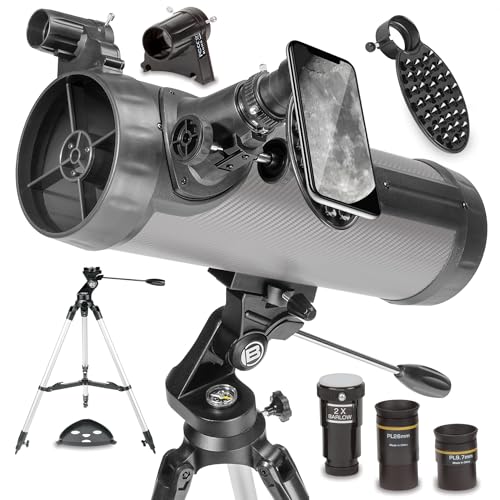
National Geographic is a name everyone knows and trusts. This 114mm Reflector Telescope is ideal for beginner to intermediate astronomy junkies who want to explore the night sky with ease. It is perfect for users interested in both casual stargazing and smartphone astrophotography tips, especially those who want to capture celestial images using their smartphones. This telescope is perfect for people looking for a versatile and portable option to enhance their views of the night sky.
This telescope is a little bigger than the one above, it’s got great power and can see deep into the unknown with ease. This has everything you need, plus it’s currently at the lowest price it’s been in 30 days, under $100 bucks, by one cent – Hope I didn’t just spoil the deal!
FEATURES:
- High magnification – 19x and 51.5x
- Full accessory package
- Top rated and great price
- A National Geographic product
Pros:
- Equipped with a 114mm reflector providing clear and bright views of planets and deep-sky objects.
- Comes with multiple eyepieces to offer varied magnification options for detailed observation.
- Includes a smartphone adapter mount for easy astrophotography and sharing of celestial images.
- Compact and portable with dimensions suitable for easy setup and transport.
- Manufactured by Explore Scientific, ensuring quality and reliability.
Cons:
- The telescope may require occasional alignment and calibration to maintain optimal performance.
- Limited to manual adjustments, which might be less convenient for advanced users seeking automated tracking.
The National Geographic 114mm Reflector Telescope features a sweet 114mm aperture that allows users to observe celestial bodies with enhanced clarity and detail. Its reflector design minimizes chromatic aberration, resulting in sharp images of the moon, planets, and some deep-sky objects. The included eyepieces offer flexibility in magnification, enabling users to customize their viewing experience based on their interests and targets in the night sky.
A game changer feature is the smartphone adapter mount. This sweet heart transforms the telescope into a powerful tool for astrophotography. Effortlessly capture and share stunning photos of astronomical phenomena! This telescope’s manageable size and sturdy construction make it an excellent choice for those who want a balance between performance and portability.
More power – Highly rated – National Geographic product – BAM!
7. 50 Best Astrophotography Targets For Beginners

When it comes to finding and viewing the great abyss we call space, have you ever wondered how to get started? Don’t you just wish there was a book that showed you what the heck you are even looking for?
The 50 Best Astrophotography Targets For Beginners is perfect for you if that question resonates like the gamma rays out of a quasar in deep space. For aspiring Astro photographers who are just starting their journey in capturing the night sky the information in this is gold.
Whether you own a basic DSLR or a beginner-friendly telescope, this guide helps simplify the complex world of astrophotography by focusing on the best celestial objects to photograph. It is perfect for hobbyists wanting to improve their skills and gain confidence in choosing the right things to search for at the right time. Quick side note – To complement your astrophotography journey, it’s important to have the right equipment, not some lame garbage camera that makes, what could have been a great picture into a fuzzy nightmare worse than your hair in the 80’s. This is why you should consider the best cameras for astrophotography beginners. Having a reliable camera allows you to capture stunning images of the night sky with clarity and detail. Even if you’re on a budget, there are several models available that provide excellent performance for those just starting out in this fascinating field.
This book will show you:
- How to get started
- Tackling close astrophotography targets like the sun and moon
- What do the targets look like
- The best time of the year to shoot them
- How big the targets are
- How to find them
- What the images look like straight out of the camera
- And much more…
FEATURES:
- Highly rated
- Available on kindle
- Under $10 bucks
Pros:
- Curated list of the easiest and most visually stunning astrophotography targets.
- Helps beginners prioritize what to photograph, reducing overwhelm.
- Published in 2018, ensuring relatively up-to-date guidance for enthusiasts.
- Suitable for various equipment levels, from entry-level cameras to beginner telescopes.
Cons:
- Lack of detailed technical instructions or camera settings.
- No physical pages as the number of pages is listed as zero, which may indicate a digital format or an incomplete listing.
- May not cover advanced or deep-sky objects for experienced astrophotographers.
This guide features a thoughtfully selected collection of 50 astrophotography targets that are accessible and worth a look for beginners. By focusing on these specific celestial objects, users can learn to identify and capture the night sky with more ease and satisfaction. The selections balance bright nebulae, star clusters, and galaxies, and more, making it easier to achieve impressive results even with modest equipment.
The benefit of this guide lies in its ability to streamline the learning process. Beginners no longer need to sift through countless targets or complicated star charts. Instead, they can concentrate on practice and refinement, building their confidence and improving their skills step-by-step. Overall, this astrophotography guide serves as a practical roadmap for anyone ready to explore astrophotography without feeling overwhelmed.
Get your copy today and get looking through that eyepiece tonight!
8. Tofficu 80w Portable Telescope Camera

The Tofficu 80w Portable Telescope Camera is great for both astronomy enthusiasts and astrophotography beginners who seek a high-quality, yet easy-to-use digital eyepiece. Whether you are just starting your journey in exploring the night sky or are an experienced user looking to capture stunning celestial images, this compact and versatile device fits perfectly into your toolkit.
Simple, inexpensive, and good results – This one is worth a look.
FEATURES:
- Plug-and-play
- Brilliant images
- Instant setup for users
- Did I mention it’s under $20 bucks?
Pros:
- High-definition digital eyepiece delivering clear and sharp astrophotography results
- Compact and lightweight design for easy portability and setup
- USB port allows simple connection to computers and other devices
- Suitable for both beginners and experienced users due to easy setup and versatile features
- Multi-color design adds aesthetic appeal
Cons:
- Limited to specific telescope compatibility depending on eyepiece size
- Requires external software or device for image processing and viewing
The Tofficu 80w Portable Telescope Camera boasts a compact size of just 1.57 inches in height and 1.77 inches in width and length, weighing only 0.14 pounds. This makes it highly portable and convenient for field use. Easily carry it to observation sites like Paul Bunion and his axe. Its a high-definition digital eyepiece that’s inexpensive and captures detailed images of celestial objects.
What more do you need? Crisp and vivid astrophotography results that can be shared or further enhanced using compatible software.
Featuring a USB port, this telescope camera ensures seamless connectivity to a wide range of devices, including laptops and desktop computers. Enjoy easy image transfer and real-time viewing. The device is designed for straightforward setup, making it accessible to beginners while still offering the performance demanded by experienced astronomers. Its multi-color design adds to the user experience by combining functionality with style, making it a great addition to any astronomy toolkit.
Grab this deal before it’s gone!
Frequently Asked Questions
What Is The Best Telescope For Beginner Astrophotography?
The HUGERSTAR 80mm refractor telescope is ideal for beginners. It offers clear views and a portable design. It includes a tripod and phone adapter for easy astrophotography.
How Can I Start Astrophotography With Smart Telescopes?
“Ready Set Image” guides beginners to use smart telescopes. These devices simplify star tracking and image capturing, making astrophotography accessible and fun.
Which Books Help Beginners Choose Astrophotography Targets?
“The 100 Best Astrophotography Targets” and “50 Best Astrophotography Targets” are excellent. They provide monthly guides and practical tips for CCD imaging with amateur telescopes.
Can I Use A Smartphone For Astrophotography?
Yes, telescopes like the National Geographic 114mm reflector include smartphone adapters. This allows easy capturing and sharing of night sky images.
What Digital Tools Assist Beginner Astrophotographers?
The Tofficu 80w portable telescope camera offers USB connectivity and HD digital eyepieces. It’s perfect for beginners seeking easy setup and quality images.
How Do I Shoot Better Night Sky Photos?
“Photography: Night Sky” offers field guidance for shooting after dark. It teaches techniques to improve clarity, composition, and exposure in astrophotography.
Conclusion
Choosing the right astrophotography setup makes capturing the night sky easier and more fun. Beginner-friendly telescopes like the HUGERSTAR 80mm refractor and National Geographic 114mm reflector offer great views without complex settings. Books such as “Astrophotography is Easy!” And “The 100 Best Astrophotography Targets” provide helpful tips and target ideas to guide your imaging journey.
Accessories like portable tripods and smartphone adapters improve stability and image quality. Digital eyepieces, like the Tofficu 80w, add convenience for beginners and advanced users alike.
Starting with simple equipment reduces frustration and helps build confidence. Remember, patience and practice are key to capturing beautiful night sky photos.
Enjoy each step and watch your skills grow over time. With the right tools and guidance, anyone can explore the stars through a lens. Your astrophotography adventure begins with the right setup and a curious mind. Who knows? Maybe you will discover a new comet, planet, civilization, or maybe just a great hobby to enjoy.
Enhance your astrophotography journey with these complementary guides:
- Best Astrophotography Cameras for Beginners – Find the right camera for your setup
- Best Beginner Telescopes Under $300 – Budget-friendly scopes that work for photos too
- Best Portable Travel Telescopes – Compact options for shooting on the go
- Best Wide Angle Binoculars for Astronomy – Locate targets before you start imaging